Overview
At Fresho, performance management was creating inconsistency and defensiveness because expectations and growth pathways were unclear.
We shifted to a capability-led system, defining core and specialty capabilities across levels, embedding structured feedback, and aligning titles to growth expectations. Adoption was co-created with the organisation, with iterative rollout and training to reinforce behaviours.
The result was clearer career paths, stronger feedback culture, and measurable improvements in engagement, learning, and recognition, moving from performance as a process to capability as a system.
Strategic Shift: Performance → Capability
At Fresho, performance management was applied before shared clarity on expectations or growth. Conversations focused on evaluation rather than development, and “high performance” varied across managers and teams.
Without defined capabilities, feedback lacked a common language, growth discussions were subjective, and performance cycles felt episodic rather than developmental.
Capability had to come first. Performance optimises for judgement; capability builds clarity, progression, and shared understanding. The shift aligned directly to the company OKR: “A Great Place to Work to Enable High-Performing Teams.”
Strategic intent
- Establish shared expectations before measuring outcomes
- Make capability the foundation, performance the outcome
- Enable continuous growth and predictable delivery
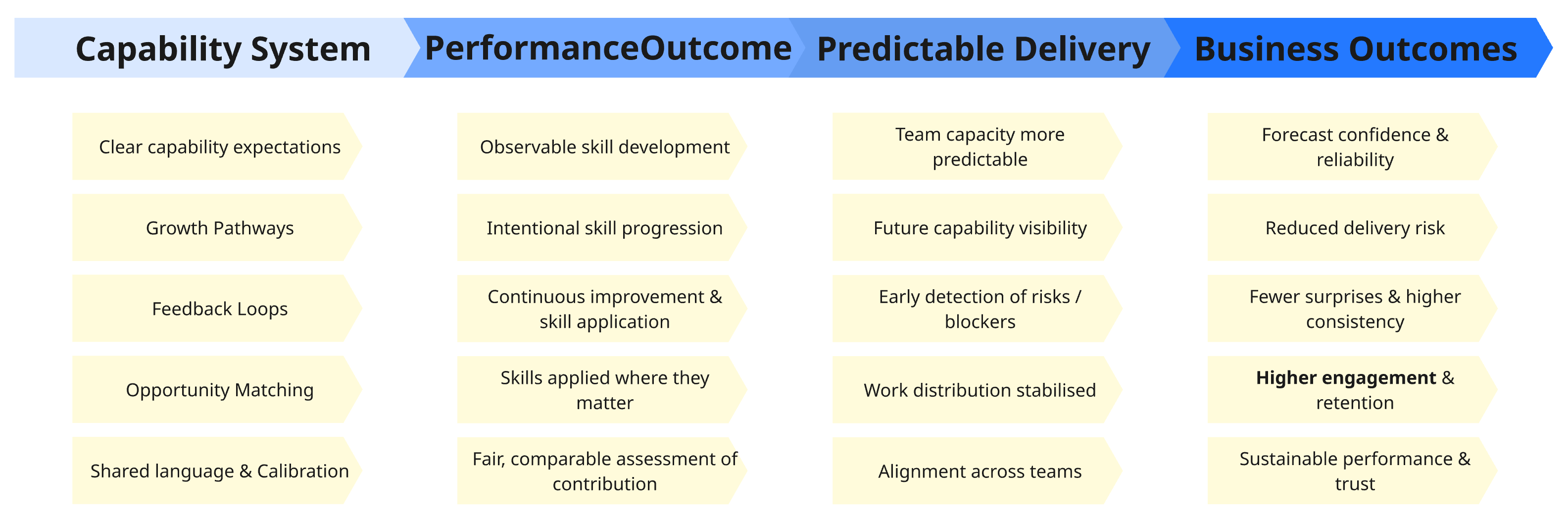
Performance is an outcome, capability is the system that produces it.
Framework Design: Scaled Core Capabilities
The framework was designed to scale across functions while remaining practical and adaptable. Core capabilities provide continuity, while specialty capabilities layer on for senior growth. Frameworks follow a shared design guide but allow function-specific divergence.
At the start of this project, the overall engineering team was 23 people. This framework represents a starting point for defining expectations and growth, and is designed to evolve over time to include additional senior roles (Staff+, Principal) and specialties such as Specialist Generalist and Delivery Lead.
Capabilities span levels from Junior to Staff+, with behaviours that are observable and actionable rather than personality traits, enabling fair calibration and transparent growth.
Key elements
- Core capabilities apply to everyone; specialty capabilities add depth for senior roles
- Progressive levels show measurable growth
- Titles aligned to capability levels, replacing inconsistent historical naming
This structure supports scale, clarity, and development paths without over-prescribing.
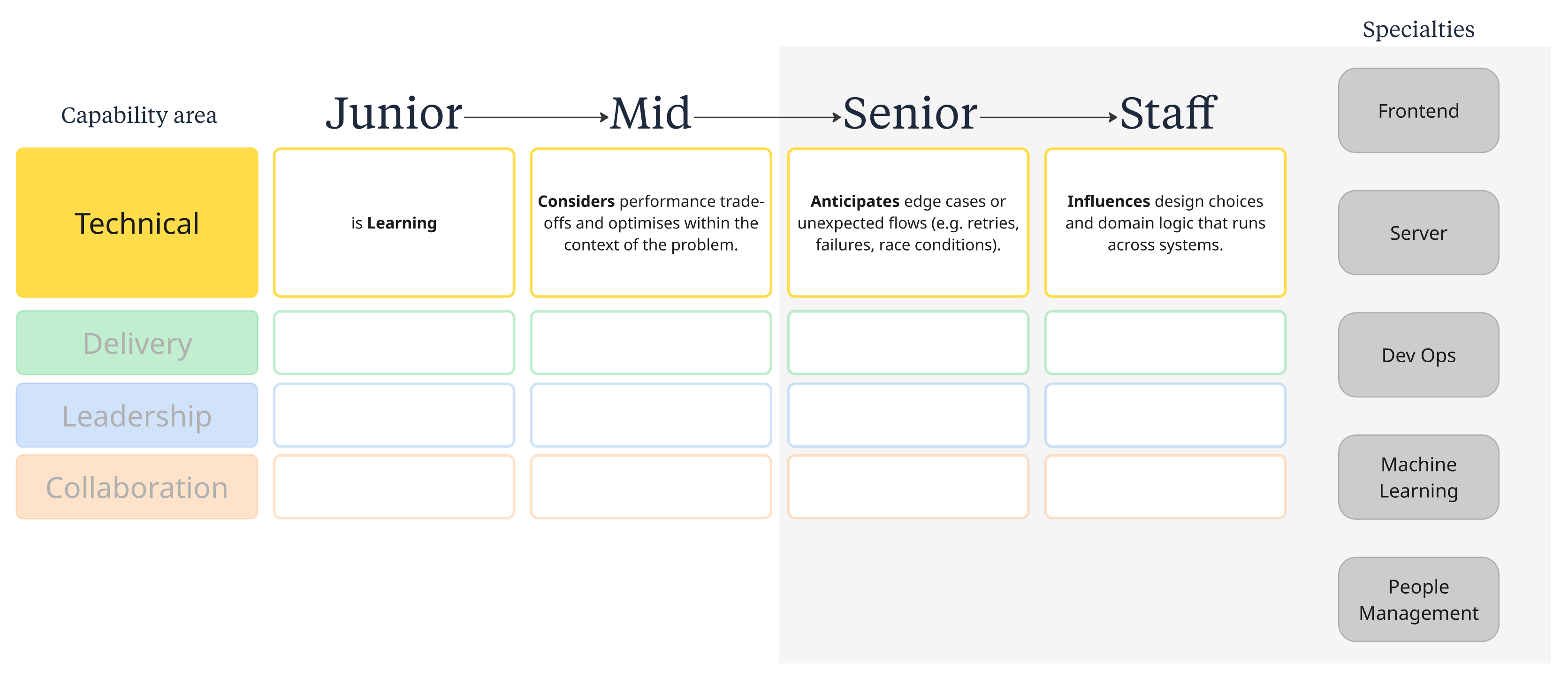
A scalable, adaptable system: core capabilities provide common ground, specialties allow depth where it matters.
Adoption by Design
Adoption was treated as a design problem, not an afterthought. Early adopters were selected across roles and levels, including advocates, skeptics, and potential disruptors. Workshops refined core and specialty capabilities before broader rollout.
Specialty capabilities were tested incrementally, with drafts reviewed, iterated, and re-tested to surface misalignment early. Organisation-wide mock assessments introduced a shared language and assessment standards, while “build in public” updates reinforced transparency and trust.
Formalisation avoided surprises. Employees self-assessed, discussed concrete examples with managers, incorporated peer input, and were calibrated before manager 1:1s confirmed placements.
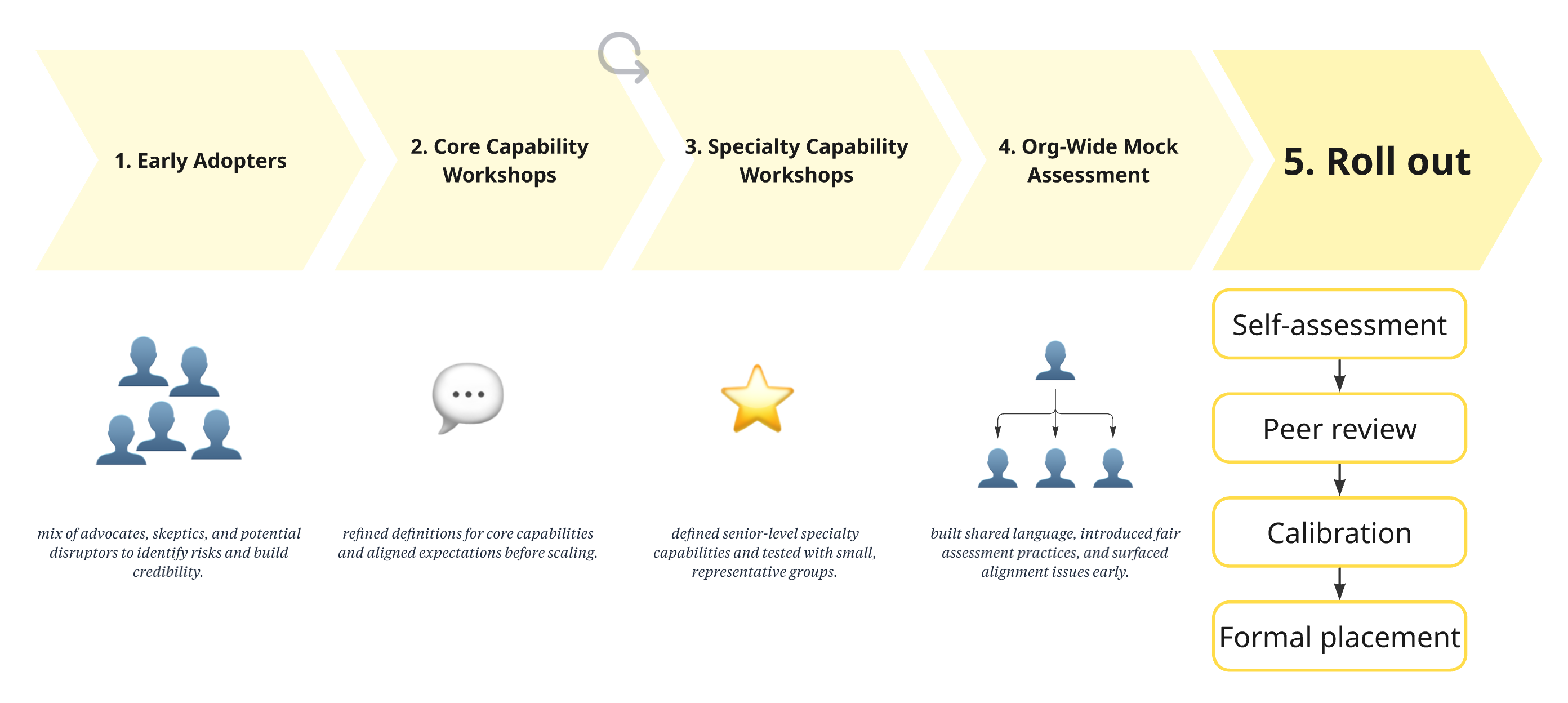
Capability lived in the organization: co-created, iterated, and embedded before formal rollout.
Feedback as the Engine
Capabilities only become meaningful when observed, named, and discussed. Feedback was the lever that transformed the framework from static documentation into lived practice.
It was framed around career development rather than evaluation, shifting ownership from managers to individuals while encouraging proactive growth conversations. f Key shifts
- Continuous feedback instead of episodic review
- Manager-led to self-initiated development
- Hierarchy-independent, peer-supported input
Training built practical skills over time:
- Giving reinforcing feedback (Situation Behaviour Impact - SBI model)
- Receiving feedback (Curious Active listening Take action - CAT model)
- Initiating constructive peer feedback
Phased feedback strategy
- Phase 1: Manager-initiated peer feedback every two months
- Phase 2: IC-initiated feedback, supported by managers
- Phase 3: Self-directed feedback at meaningful moments (future)
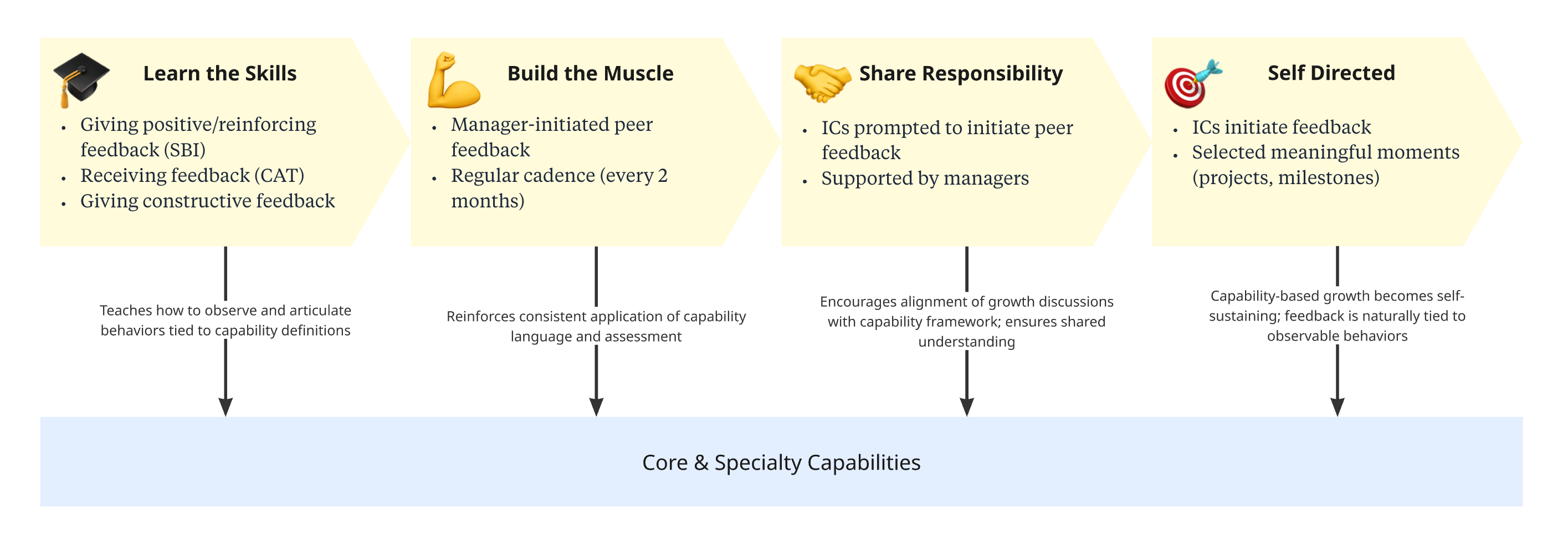
Feedback is the engine that drives growth in core and specialty capabilities, evolving from training to self-directed practice.
How Performance Is Measured
Performance is not separate. It emerges from how capabilities are applied to deliver impact.
Assessment dimensions
- Capability level: Observable behaviours across core and specialty areas; holistic, not averaged
- Progress within level: Levels represent growth bands; early versus advanced placement recognised
- Impact at level: Reflects how effectively capabilities are applied at expected scope and influence
This keeps performance conversations focused on growth, fairness, and real impact, avoiding ratings or output-based scoring.
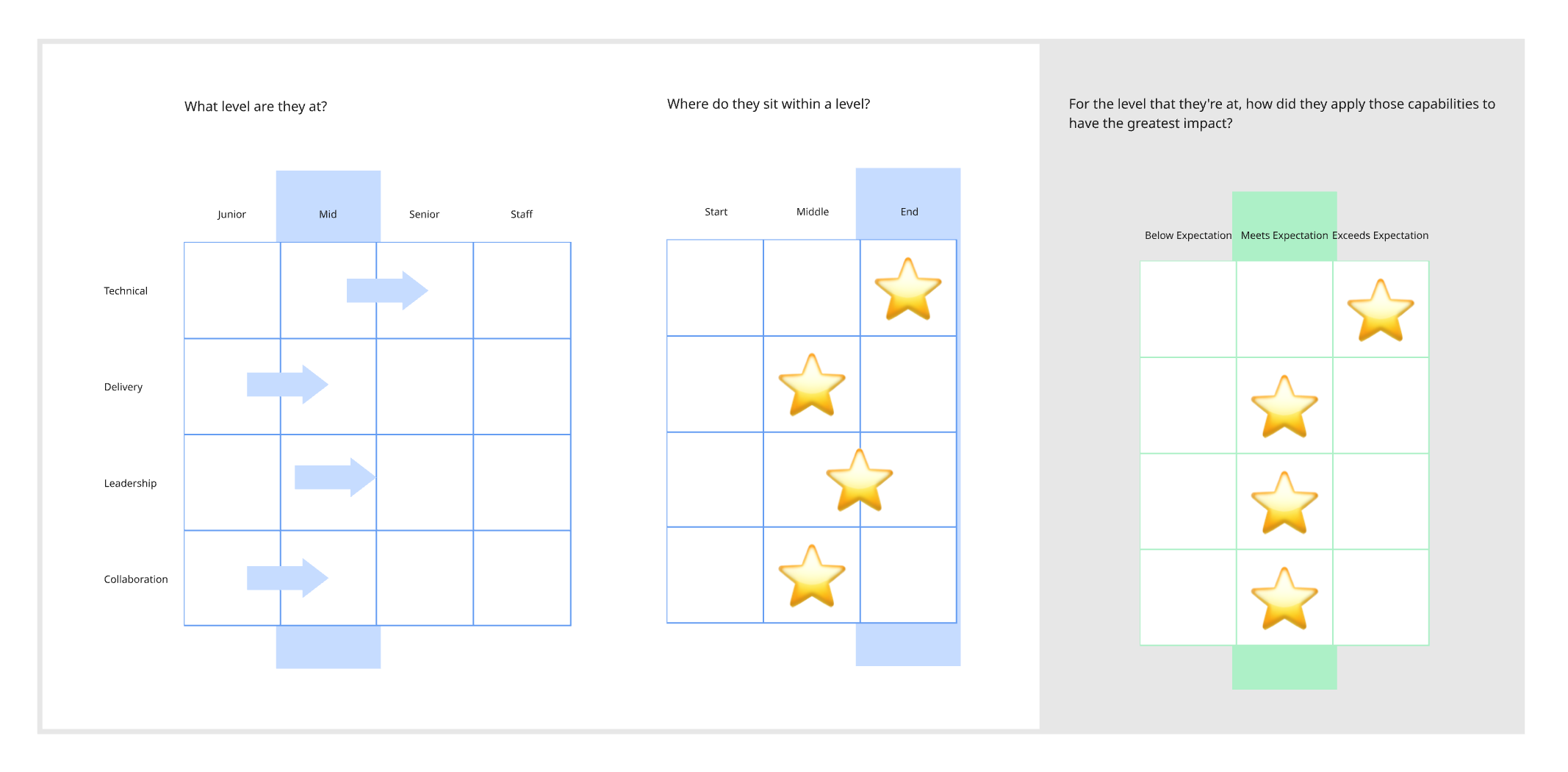
Capability sets expectations. Impact reveals performance.
Operating Model: Growth Flywheel
The system operates as a continuous loop. Capability defines expectations, feedback translates work into insight, growth plans guide opportunity, real projects enable practice, and assessment refines priorities.
Over time, this flywheel strengthens, allowing capability development to scale alongside the business.
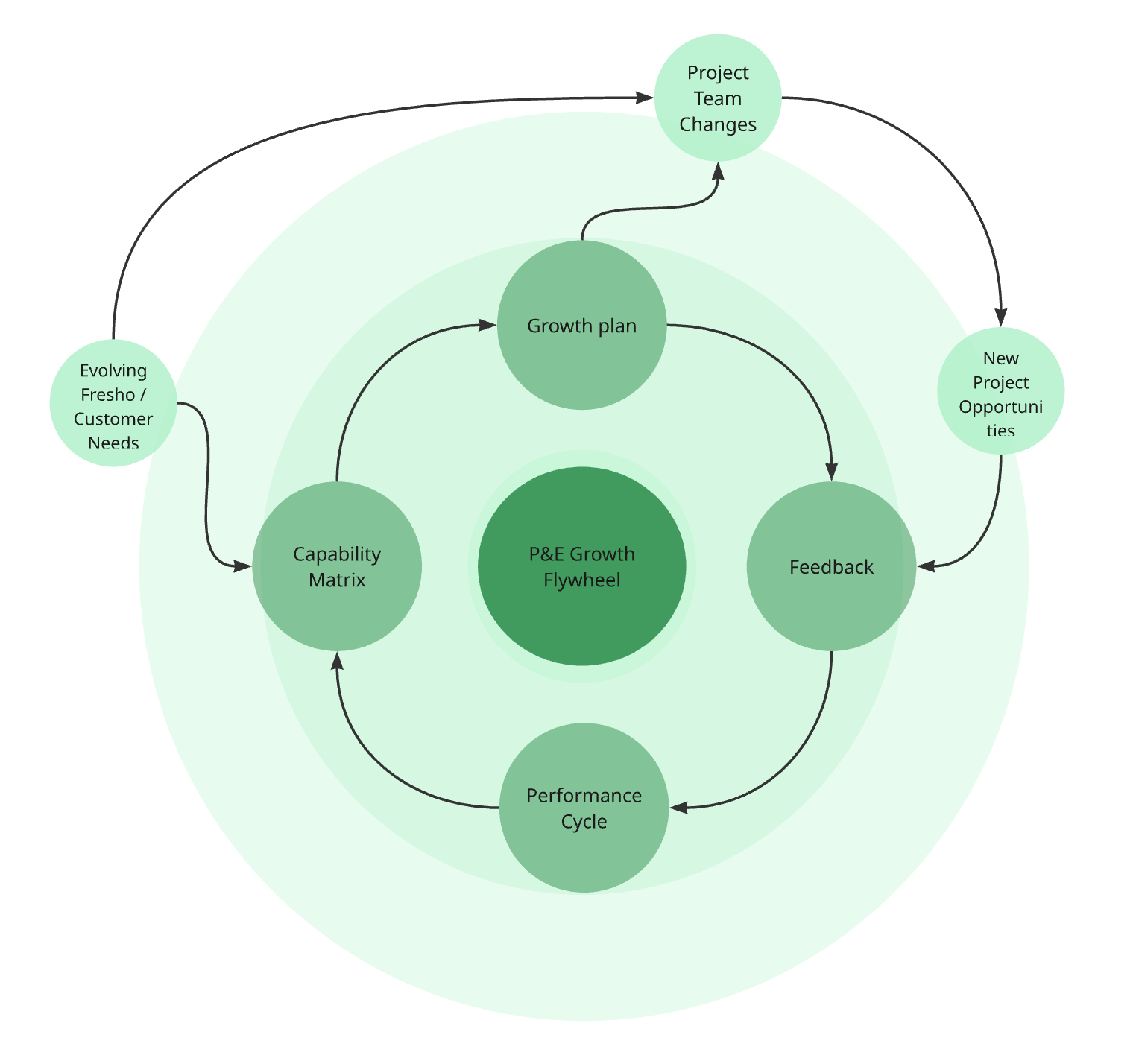
A self-reinforcing system where capabilities, feedback, and growth plans continuously feed each other to make people growth the default mode of operation.
Delivery Model & Constraints
Delivery was led by a small, cross-disciplinary team: one internal engineer and one external HR consultant. This paired deep organisational context with expertise in growth systems, feedback design, and holocratic environments.
The engagement was scoped by working backwards from outcomes, defining success metrics and a full roadmap in the first two hours. Limited internal capacity enabled rapid experimentation without heavy process.
Complementary strengths
- Internal engineer: context, tenure, real-time testing
- External consultant: HR systems expertise, adult development, prior experience in holocratic systems
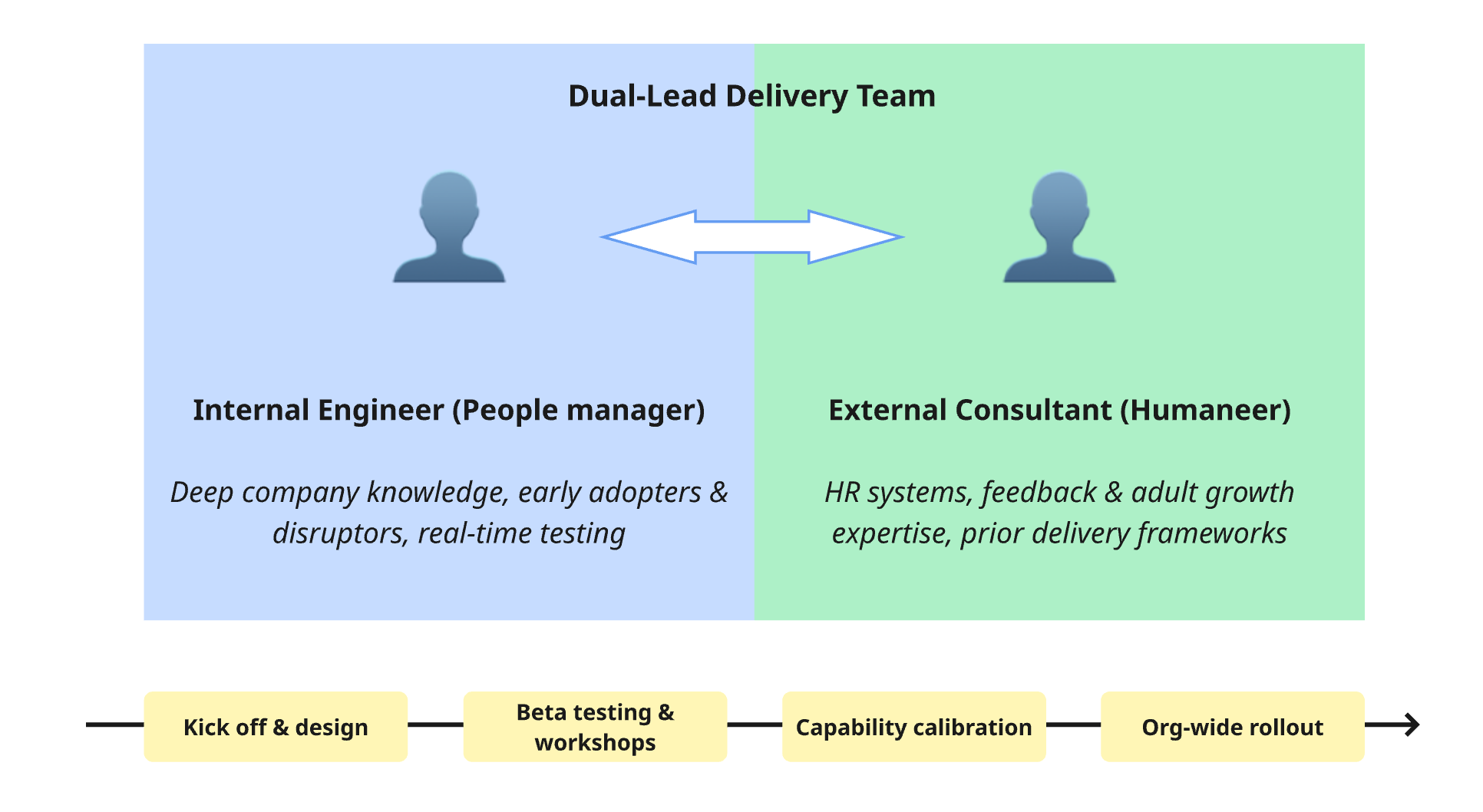
Dual-lead delivery model delivered discipline without bureaucracy, leveraging complementary skills to implement a scalable capability framework.
Outcomes
System-level results demonstrated alignment, trust, and behavioural change.
- Engagement survey participation increased 65% to 95%
- Learning and Development scores improved, especially career clarity and manager support
- Feedback and Recognition scores strengthened over time
These results show a shift from performance management as a process to capability development as a system.
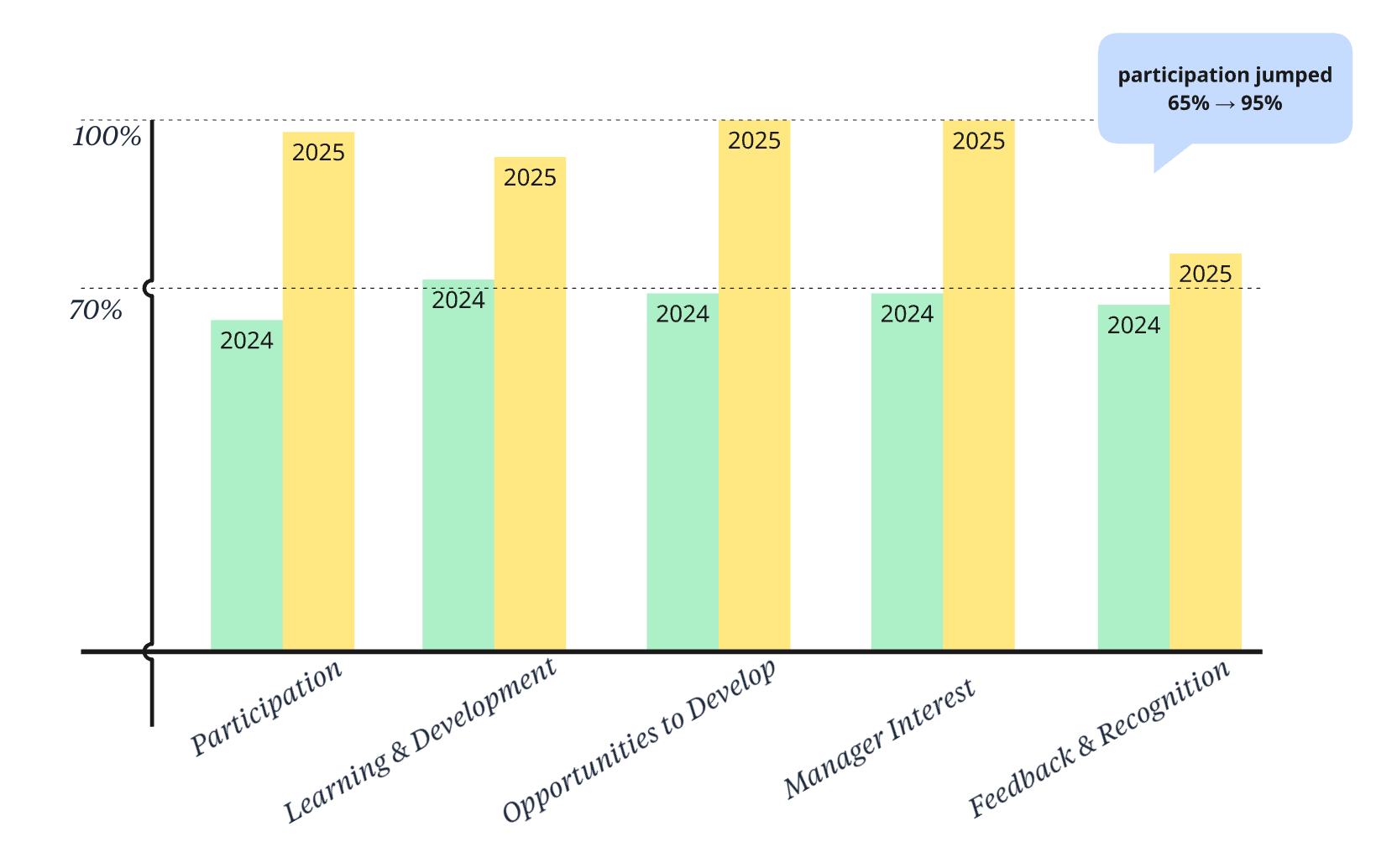
Systemic change drives engagement, clarity, and trust - not just tick-box improvements.
Reflection
Capability must come before performance. Measuring outcomes without shared expectations optimises reporting, not results.
Adoption mattered more than design. The framework worked because it was co-created, reinforced through behaviour, and visible in everyday conversations. Feedback was the hardest and most powerful lever. Capability only becomes real when people can observe it, name it, and talk about it safely.
This framework is a living system. As the organisation grows and new roles or specialties emerge, the capabilities and assessment practices are expected to evolve, ensuring the system continues to support clarity, development, and high performance.